




درباره ژن کاوش آزما
How GenKavosh Works
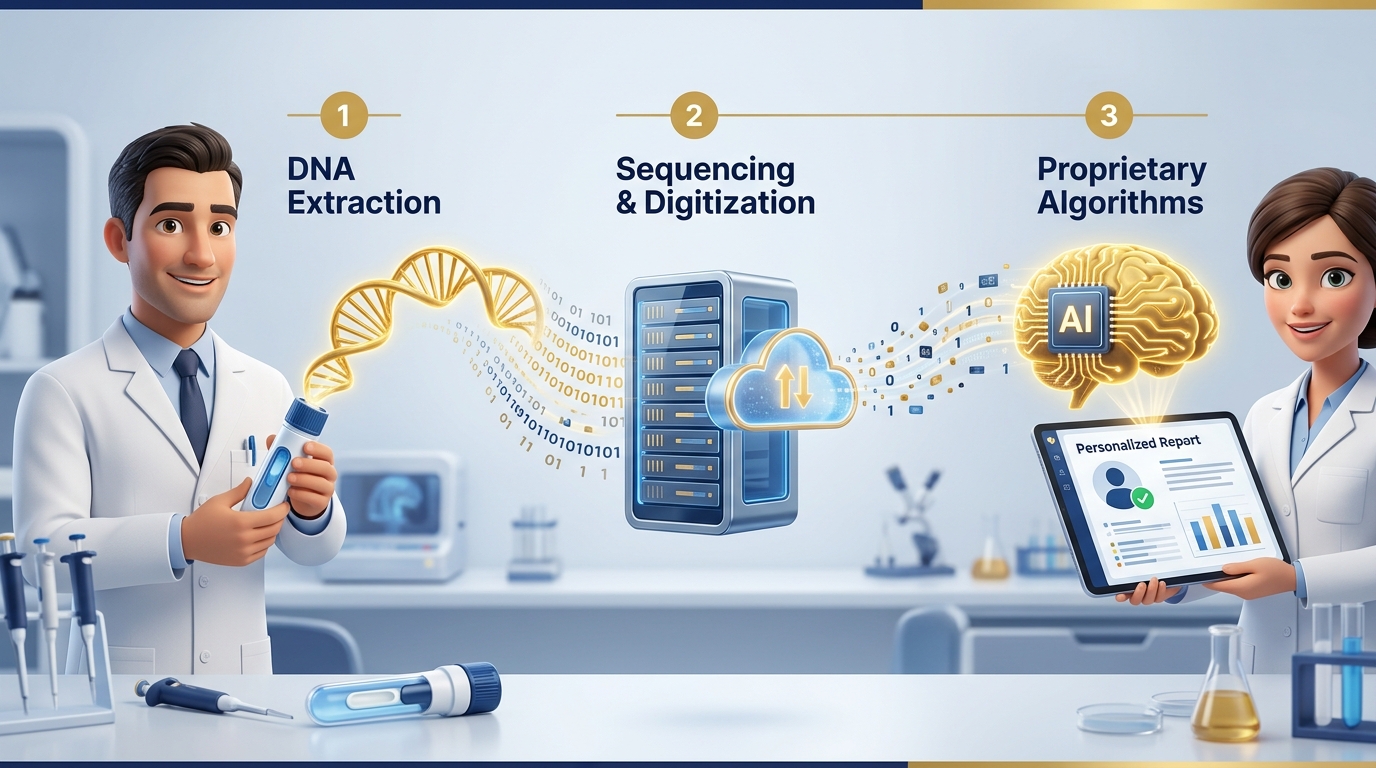
The Process of Creating Your Personalized Health Report: From Biological Data to Scientific Insight.
Your Personalized Report Journey
We combine biological processes with advanced computational algorithms to process vast amounts of information without compromising scientific accuracy, delivering precise and detailed reports.
DNA Extraction
DNA is extracted from the saliva sample you sent us. If your DNA has already been sequenced, we skip this step and proceed directly to raw data analysis.
Sequencing (Digitization)
Biological data within the DNA is converted into digital data. This process, known as Sequencing, creates your unique genetic map.
Proprietary Algorithms
GenKavosh’s exclusive algorithms are applied to this computerized data to generate your personalized report, analyzing thousands of scientific papers.
How Our Algorithm Works
The GenKavosh algorithm is designed based on the analysis of thousands of scientific papers validated by the international scientific community. This adds significant value to our reports.
1. Ethnicity & Gender Identification
The first step in genetic analysis is identifying each individual's gender and ethnic background. We specifically use studies relevant to each individual. For example, when preparing a genetic report for a European woman, we do not use studies conducted solely on men or Asian populations.
2. AI-Powered Precision
Instead of simple analysis, we employ Artificial Intelligence to combine a large number of reputable articles. This allows us to utilize all available scientific knowledge to calculate genetic predispositions with significantly higher accuracy and validity.
Analysis Methodology
Our genetic reports are prepared based on three types of analysis methods:
This study compares DNA markers across the entire genome of individuals with a specific trait or disease against those without it. It is statistically based and considers many genes that are indirectly but meaningfully linked to a predisposition.
In this method, our algorithm analyzes multiple genetic variants or mutations in one or more genes that have a more direct connection to the genetic predisposition.
In this method, only a single variant of a specific gene determines the genetic predisposition because it has a very strong correlation with the genotype.
Note: Each trait discussed in this report has been analyzed using one of these three methods.
Complex vs. Hereditary Diseases
The information provided in our reports relates to predispositions. But what do we mean by predisposition?
Complex Diseases
Factors: Genetics + Environment/Lifestyle.
Analysis: GWAS, Multivariate, and Monovariate.
Example (Diabetes): Genetic factors indicate your natural predisposition. Environmental factors include diet, lifestyle, stress, location, climate, and age. Whether you develop diabetes depends on the combination of both. Even with a genetic predisposition, maintaining a healthy weight, controlling glucose intake, managing stress, and exercising can prevent the disease.
Hereditary Diseases
Factors: Genetics Only (Mutations).
Analysis: Monovariate or Multivariate.
Explanation: A specific change or mutation in a gene determines the predisposition. Environmental factors play no role in causing the disease itself. However, concepts like Penetrance (percentage of people with the mutation who develop the disease) and Expressivity (spectrum of clinical symptoms) apply. A mutation may cause the disease or not, and severity can vary widely.
You may encounter diseases in your report that cannot manifest in you due to your biological sex (e.g., Ovarian Cancer in males). We do not remove this information because you may be a carrier of the mutation and could pass it to your children, who might develop the disease. Therefore, this information remains valuable for family planning.
Key Genetic Concepts
What is a Genetic Variant?
A variant (also called a mutation or change) is a permanent alteration in the DNA sequence that makes up a gene. These variations determine individual predispositions. In every section of your report, you will see information about the gene(s) associated with that trait. One or more variants in that gene determine how your predisposition differs from others.
Example: In Thyroid Cancer, variants rs77316810 and rs79781594 in the RET gene may indicate a predisposition.
Why Genetic Testing Matters
All humans share a common ancestor and nearly identical genomic sequences. The tiny fraction of "genetic polymorphisms" is what distinguishes us and causes certain traits or diseases to appear or not.
Previously, genetic testing was limited to newborns with metabolic issues or couples considering consanguineous marriage. Today, knowing your genetic map is essential. It allows us to predict the onset of diseases in you and your family, identify unique potential traits, and manage them optimally.
With modern technology, a simple saliva sample reveals your genetic information, allowing you to manage your health and unique predispositions faster and more effectively.
Technical Information & Sampling
Target Audience
All individuals, especially infants and adolescents.
Sample Type
Saliva.
Testing Method
Sequencing of selected nucleotide markers at genomic points with genetic polymorphisms.
Accuracy
Approximately 99.95%. No genetic test has 100% accuracy due to potential reading errors in sequences.
Sampling Instructions
- Refrain from eating, drinking, smoking, or chewing gum for one hour before sampling.
- Complete and sign the Panel Request Form (Form 1) and Consent Forms (Forms 2 & 3).
- Perform sampling according to the guide provided in the kit box.
Definitions:
Nucleotide: Composed of one of four basic nuclei: Cytosine (C), Guanine (G), Adenine (A), or Thymine (T).
Genetic Polymorphism: The replacement of any nucleotide with another, resulting in a genetic change relative to the reference genome.
Recessive Hereditary Diseases: Require mutations in both copies of the gene (one from each parent). Parents may be asymptomatic carriers.
Dominant Hereditary Diseases: Require a mutation in only one copy of the gene. Adults with these mutations also have one normal copy. There is a 50% chance of passing the mutated version to each child.
ICD-11: The World Health Organization's reference system for defining diseases, assigning a unique code to each disease and group.
Panel: A collection of related diseases and traits.
Genoscope: A set of panels available for purchase as a genetic test from GenKavosh Azma Company.
Partner Company: All sequencing and interpretation tests are performed by 24genetics, which holds valid international certifications.
Partner Laboratory: We are proud to collaborate with Dr. Farhud's Genetics Laboratory (the father of genetics in Iran). Genetic sequence confirmation and therapeutic consultations are conducted under the supervision of Dr. Farhud.
Ready to Discover Your Genetic Map?
Understanding your genetic makeup empowers you to manage your health proactively. Start your journey with GenKavosh today.
Order Your Kit Now